
Style and format
- File format: manuscripts must be submitted in any editable format, e.g. DOC, DOCX or RTF.
- Length: there is no length restriction.
- Font: any.
- Headings: sections and subsections should be limited to three heading levels, with the level clearly indicated in the text.
- Layout and spacing: single line spacing, no columns.
- Page numbers: number every page continuously (do not restart or split the numbering).
- Footnotes: footnotes are allowed, although it is preferable to place that information in the main text or in the references.
- Language: manuscripts may be submitted in any language, preferably Spanish and/or English (translations of the manuscript or a translated abstract may be sent as supporting information).
- Abbreviations: define abbreviations the first time they appear in the text. Keep abbreviations to a minimum and avoid non-standard ones unless they are used more than three times in the text.
- Reference style: APA, 7th edition, for all articles (only purely technical articles may use IEEE, with the prior approval of the editorial team). Include the DOI of every reference whenever one exists.
- Equations: where possible, insert individual symbols as normal text with the correct Unicode (hexadecimal) values, and make sure the whole equation is included. We recommend MathType, an equation editor or the Insert > Equation function in Microsoft Word.
- Nomenclature: use correct, commonly established and universal nomenclature whenever possible.
- Units of measurement: International System of Units (SI).
Suggested structure of the manuscript
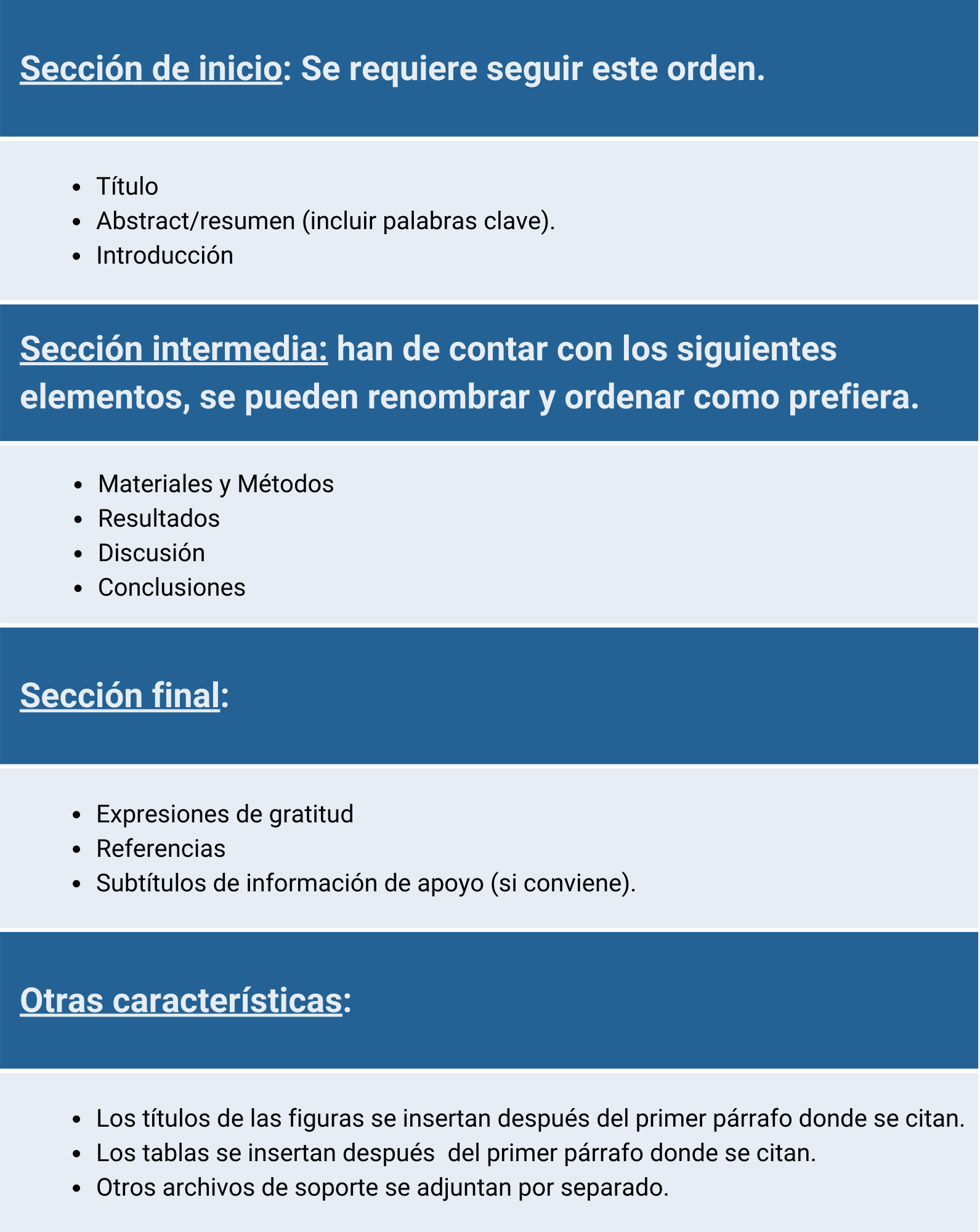
Parts of the manuscript
- Title: the title must be concise, specific and relevant, and reflect the type of study: trial data, systematic review, meta-analysis, etc.
- Author list (to be added once the blind review process is complete): authors are listed in order of their contribution to the study, with full names (given name followed by surname(s)). Below the author list, give each author's affiliation in order of appearance. The corresponding author handles the submission, and the email address they provide will appear in the article.
- Abstract: a maximum of about 250 words, in a single paragraph that follows the structure of the paper but without headings.
- Keywords: from 2 (recommended) to 5 (maximum).
- Classification codes / Clasificación temática: below the keywords, 2 to 4 JEL codes (Journal of Economic Literature) and 1 or 2 OECD FOS codes (Fields of Science and Technology).
- Key Quotes for Citation / Frases clave para citar: a compulsory section immediately after the abstract and keywords, before the introduction, with the official citation of the article in APA 7th ed. and 2 to 4 key statements (1 or 2 sentences, maximum 40–50 words each) in the language of the manuscript and in English. Full guidelines and an example are available under Submissions.
- Introduction: briefly place the study in a broad context and explain why it matters. Define the purpose of the work, including any specific hypotheses being tested. Review the current state of the field carefully and cite the key publications. Like the rest of the paper, it must be written in clear, precise and understandable language.
- Materials and methods: describe them in enough detail for others to replicate and build on the published results. New methods and protocols must be described in detail, while well-established methods can be described briefly and properly cited. Give the name and version of any software used and state whether it is available. This section is not required for literature reviews or opinion pieces.
- Results: provide a concise and precise description of the results, their interpretation and the conclusions that can be drawn from them.
- Discussion: discuss the results and how they can be interpreted in the light of previous studies and of the working hypotheses. Discuss the findings and their implications in the broadest possible context, and highlight the limitations of the work. Future research directions may also be mentioned. This section may be combined with the results.
- Conclusions: this section is optional, but may be added if the discussion is unusually long or complex.
- Patents and designs: optional; may be added if patents or industrial designs result from the work reported.
- Acknowledgements: must disclose all sources of funding for the study. State clearly any grants received to support the research.
- Author contributions: each author is expected to have made substantial contributions to the conception or design of the work, or to the acquisition, analysis or interpretation of data, or to the creation of new software used in the work; to have drafted the work or substantially revised it; to have approved the submitted version (and any substantially edited version involving the author's contribution); and to agree to be personally accountable for their own contributions and to ensure that questions related to the accuracy or integrity of any part of the work, even those in which the author was not personally involved, are properly investigated, resolved and documented in the literature.
For research articles with several authors, a short paragraph specifying their individual contributions must be provided, using the CRediT taxonomy, for example: "Conceptualisation: XX and YY; Methodology: XX; Software: XX; Validation: XX, YY and ZZ; Formal analysis: XX; Investigation: XX; Resources: XX; Data curation: XX; Writing – original draft: XX; Writing – review and editing: XX; Visualisation: XX; Supervision: XX; Project administration: XX; Funding acquisition: YY".
- References: listed alphabetically by the first author's surname, in APA style, 7th edition.
- Figures and tables
- Statistical reporting
- Data reporting
- Other supporting information: supplementary material. Additional data and files can be uploaded as "Supplementary files" during submission. They will also be available to reviewers as part of the peer-review process. Any file format is acceptable, although common, non-proprietary formats are recommended whenever possible.
Preparing the file for blind review:
- Submit the article as a text file that does not identify its authors.
- In self-citations, use only "Author" and the year.
- Make sure that authorship has been removed from the document properties.
- Include a separate file with the authors' details and contact information.
Submission process
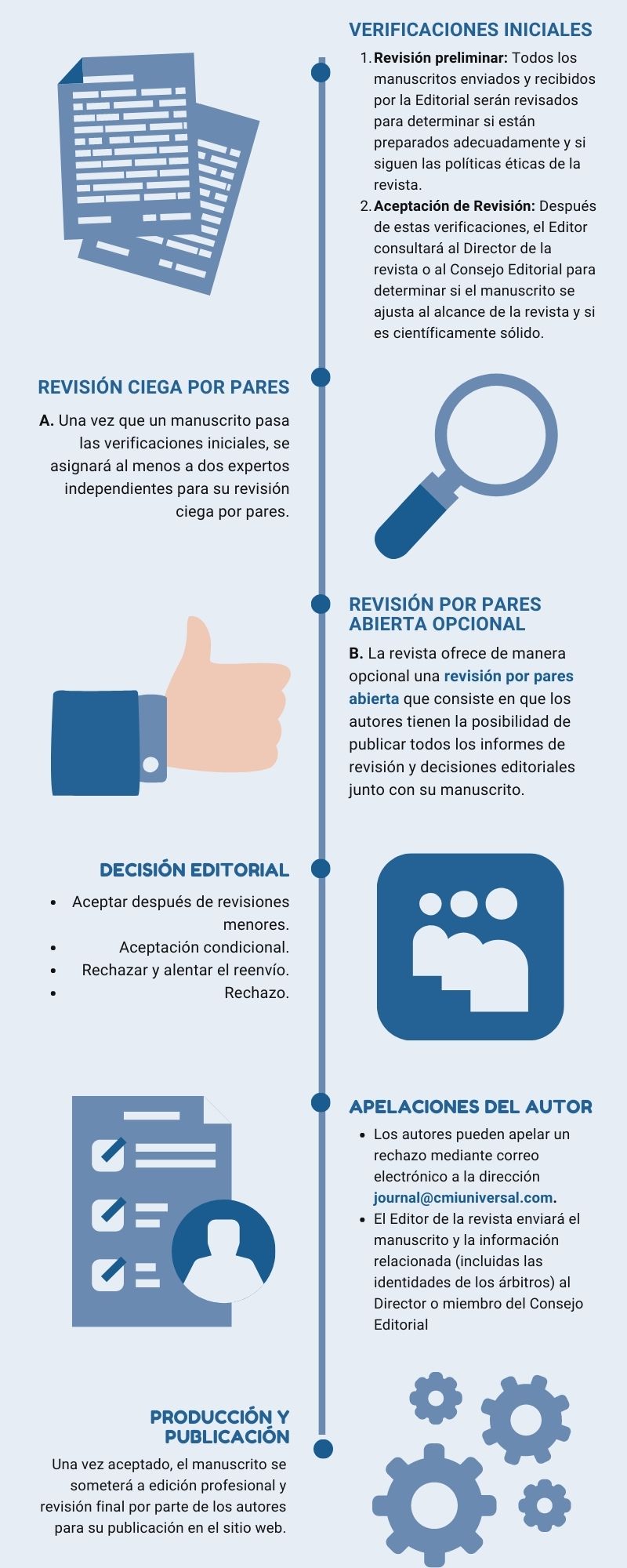
To submit a manuscript, register on the journal's OJS platform and submit the document from your personal area.
If you have any technical problem submitting your article, contact the editors directly by email: journal@cmi.es
The submitting author is responsible for the manuscript during submission and peer review, and must ensure that all eligible co-authors have been included in the author list and that all of them have read and approved the submitted version.
Editorial procedures and peer review
Figures, schemes and tables
All of them must have a short title and an explanatory caption, and be inserted in the main text after the paragraph where they are first cited. Number them in order of appearance.
- Figures and schemes: attach them with the manuscript in a single zip file, at good resolution (recommended minimum: 1,000 pixels wide/high, or 300 dpi or higher). They may be in colour.
Preferred formats: TIFF, JPEG, EPS and PDF.
- Multimedia files: may be included in the article itself or as supplementary material.
- Tables: each column needs an explanatory heading.
Small fonts may be used for large tables, but not smaller than 8 pt.
Tables may be created with the table function of word processors.
- Statistical reporting: so that the analysis can be replicated, make sure results are reported rigorously according to community standards and that the statistical methods used are appropriate for the study design.
- Data reporting: all data and related metadata underlying the findings reported in a submitted manuscript should be deposited in an appropriate, accessible public repository, unless they are already provided as part of the article.
Information required with the submission
- Cover letter
Each submission must include a cover letter. It should be concise and explain why the content of the paper is significant, placing the findings in the context of existing work, and why it fits the scope of the journal. Confirm that neither the manuscript nor any part of its content is currently under consideration or published in another journal.
- Funding statement
Describe the sources of funding that have supported the work. It is important to gather these details before submission, because the funding statement cannot be changed after the initial submission without the journal's approval. If your manuscript is published, the statement will appear in the Funding section of the article.
The statement should include, as applicable:
- Specific grant references
- Awards and the authors who received them
- Names of the organisations that funded the study or the authors
- Initials of authors who received a salary or other financial support from organisations
- URLs of sponsors' websites
Also state whether any sponsor or funder (other than the named authors) played any role in:
- Study design
- Data collection and analysis
- Decision to publish
- Preparation of the manuscript
If they played no role in the research, include this sentence: "The funders had no role in study design, data collection and analysis, decision to publish, or preparation of the manuscript".
If the study received no funding, include this sentence as the funding statement: "The author(s) received no specific funding for this work".
Research and publication ethics
- Conflicts of interest:
A conflict of interest (or competing interest) exists when anything interferes with the full and objective presentation, peer review, editorial decision-making or publication of research or non-research articles submitted to Conscious Management Journal.
Declaring all potential interests is an essential requirement of the journal and an integral part of transparent research reporting. If there is no conflict of interest, state: "The authors declare no conflict of interest". Any role of the project's funders must also be declared in this section.
Failure to declare interests may result in the immediate rejection of a manuscript. If an interest is disclosed after publication, we will act in accordance with COPE guidelines and issue a public notice. Likewise, everyone involved in the peer-review process, including authors, editors, reviewers and readers, must declare all potentially competing interests, current or future:
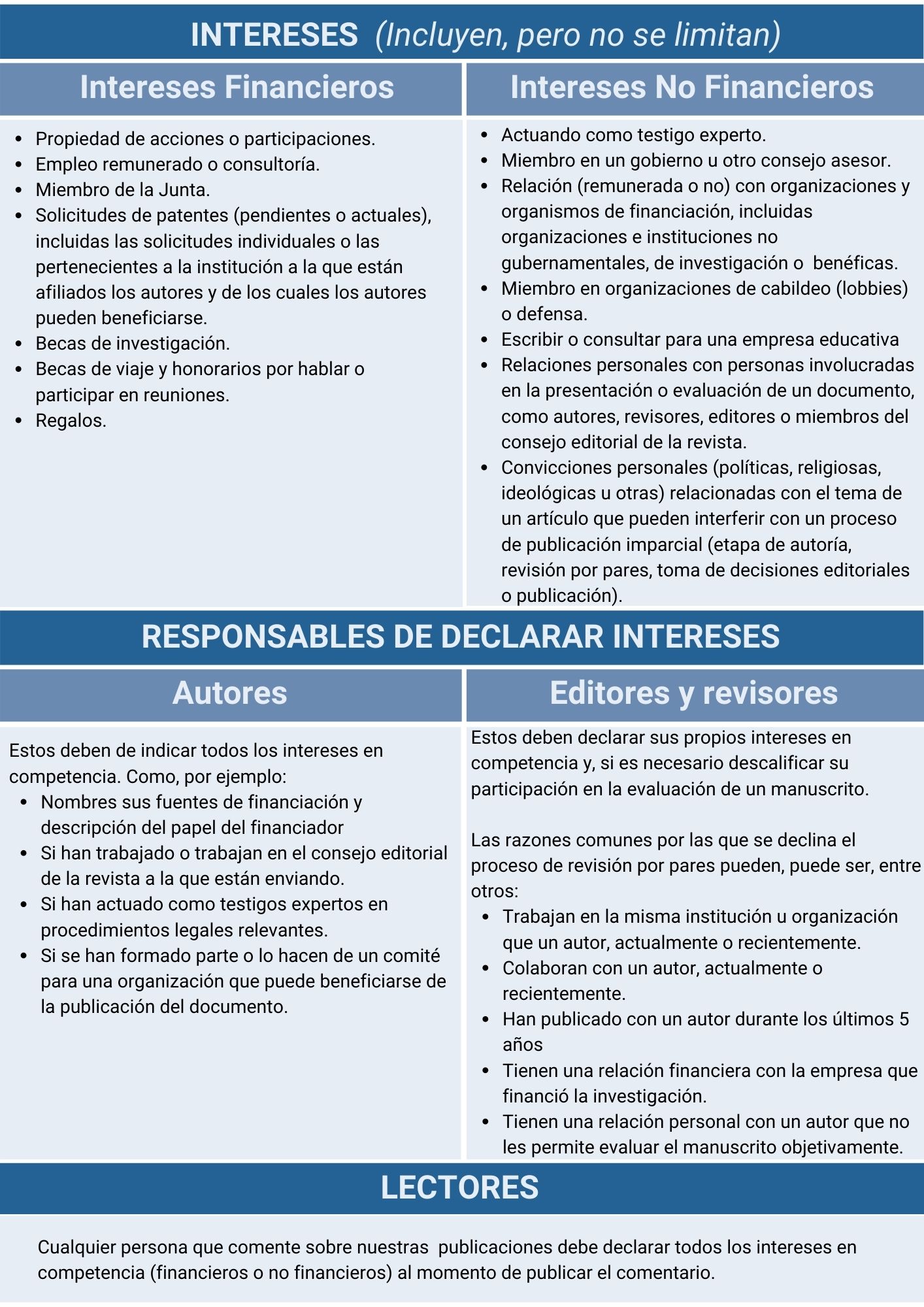
- Authorship:
To qualify for authorship of a manuscript, the following criteria must be met:
- Substantial contributions to the conception or design of the work, or to the acquisition, analysis or interpretation of data for the work:
- Drafting the work or revising it critically for important intellectual content.
- Final approval of the version to be published.
- Agreement to be accountable for all aspects of the work, ensuring that questions related to the accuracy or integrity of any part of it are properly investigated and resolved.
- Those who contributed to the work but do not qualify for authorship should be listed in the acknowledgements.
- Any change to the author list must be approved by all authors, including any who have been removed. The corresponding author acts as the point of contact between the editor and the other authors.
- Editors and journal staff as authors
Editorial independence is extremely important. Editorial staff and editors must not take part in processing their own academic work, which is assigned to at least two independent external reviewers. Decisions on such papers are taken by the Director, the Editor or the Editorial Board members with no conflict of interest with the author.
- Plagiarism statement
Our journal does not tolerate plagiarism, data fabrication, image manipulation or any other comparable misconduct in the preparation of manuscripts:
- Copying text, ideas, images or data from another source or from one's own publications without crediting the original source and referencing it correctly according to the adopted style.
- If the design, structure or wording has been inspired by previous work, that work must be cited explicitly.
- Image files must not be manipulated or adjusted in any way that could lead to misinterpretation of the information provided by the original image.
If plagiarism is detected during preliminary acceptance or review, the manuscript may be rejected. If it is detected after publication, a correction may be published or the paper retracted.
Our editors will investigate any allegation of publication misconduct and, if necessary, may contact the authors' institutions or funders. If evidence of misconduct is found, appropriate action will be taken to correct or retract the publication. Authors are expected to follow best ethical publishing practice when submitting their manuscripts.
See also the journal's full editorial policies.